First Semester Final Exam

Before we all left for Christmas break students took a final exam in US History. The classes were given 69 terms which spanned the entire first semester’s educational learning and were asked to create a concept web with them. According to inspiration.com, a concept map/web is used as a

learning and teaching technique, to visually illustrate the relationships between concepts and ideas. Often represented in circles or boxes, concepts are linked by words and phrases that explain the connection between the ideas, helping students organize and structure their thoughts to further understand information and discover new relationships. Most concept maps represent a hierarchical structure, with the overall, broad concept first with connected sub-topics, more specific concepts, following.
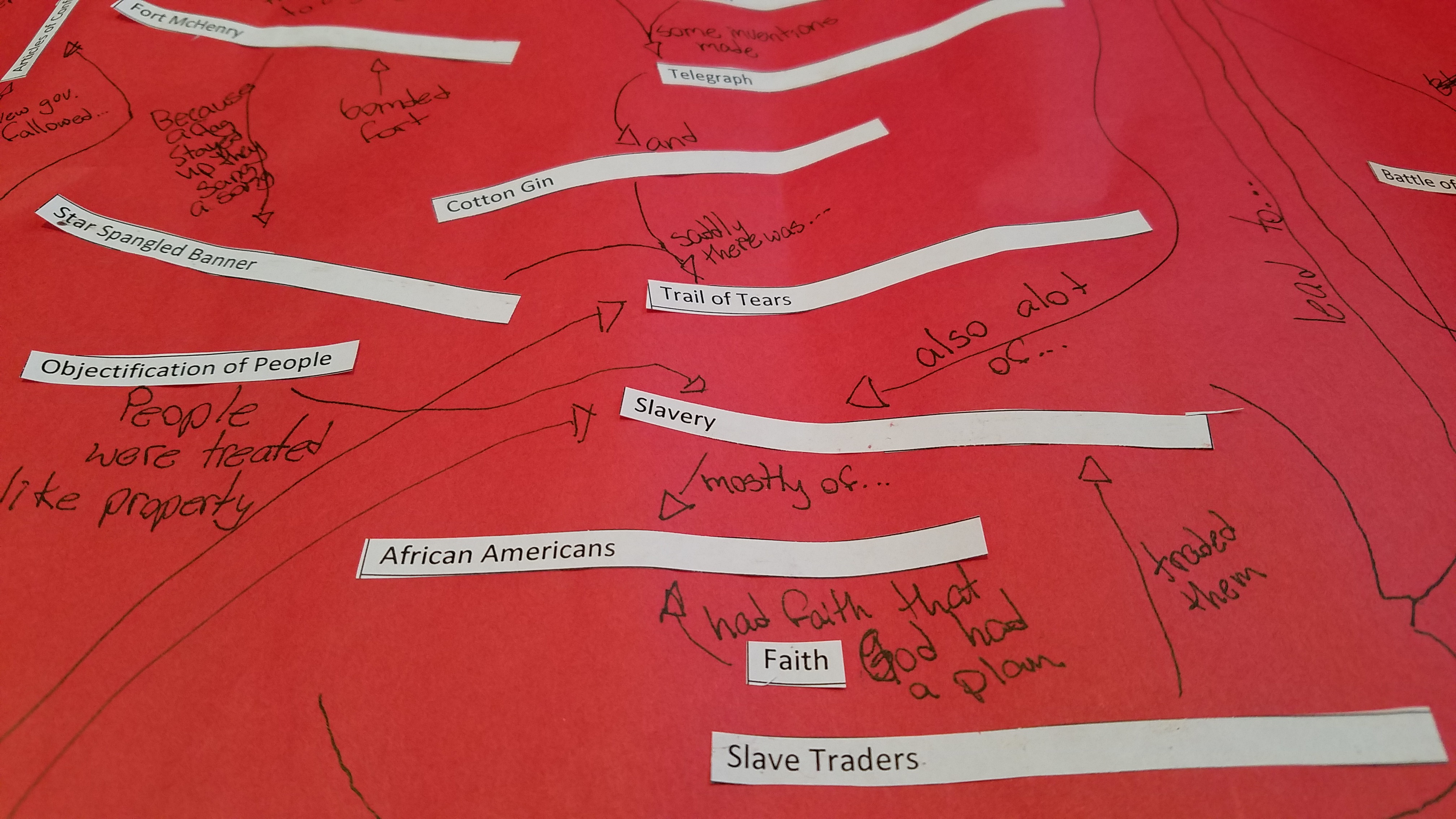
20170108_101658_001This visual representation of their learning asked students to apply and analyze the information they learned about US history thus far by categorizing, comparing and contrasting, and organizing the terms into chronological order, connecting terms into relationships, and creating larger concept umbrellas. For example, a student should be able to place the term “Gettysburg” after “Yorktown,” connect the two with the word “warfare,” and perhaps further umbrella all three terms with a fourth, such as “faith,” “hope”, “African-Americans,” or “Native Americans,” depending on their train of thought and rationale.

Here are a few photos of the end result. Next time I’ll provide white butcher paper so that I can read their work easier. Smiling!

Uncle Tom’s Cabin

In 1851, after the enactment by the United States Congress of a Fugitive Slave Act (the effect of which was to return Africans and African-Americans who had escaped from slavery in the Southern states and were living in the North, back into captivity), the editor of an antislavery periodical asked Harriet Beecher Stowe if she could supply him with a timely story or article. Stowe agreed to write a fictional piece about the lives of several slaves on a Kentucky plantation.* This fictional piece, Uncle Tom’s Cabin, is written about actual people and their lives, although some characters were developed wholly by Stowe, all to illustrate the condition of slavery. The narrative wonderfully explains the 1850s from many different sides of the story. For well-rounded insight into this era, I highly recommend reading this book.

Students in our US History class have been reading Uncle Tom’s Cabin since the beginning of the school year. There intermittent tests on certain chapters ask critical thinking questions such as, “What does Eva’s death mean to you?” and “Why is this text worth reading?” also “There are many important ideas/themes in this book. Name three and explain why they are important.” and finally, “Rather than reading Uncle Tom’s Cabin for sheer pleasure, we are reading this book to understand and appreciate a worldview. According to you, what worldview might that be? Explain.” Below are some responses to these questions from students in our class. There is also a photo gallery below showing some of the writing of the students. So proud of them! Continue reading “Uncle Tom’s Cabin”

The Civil War Project

This month students in the US History class have been discussing the Civil War. This war is the central event in America’s historical consciousness. While the Revolution of 1776-1783 created the United States, the Civil War of 1861-1865 determined what kind of nation it would be. The war resolved two fundamental questions left unresolved by the revolution: whether the United States was to be a dissolvable confederation of sovereign states or an indivisible nation with a sovereign national government; and whether this nation, born of a declaration that all men were created with an equal right to liberty, would continue to exist as the largest slaveholding country in the world.

Northern victory in the war preserved the United States as one nation and ended the institution of slavery that had divided the country from its beginning. But these achievements came at the cost of 625,000 lives–nearly as many American soldiers as died in all the other wars in which this country has fought combined. The American Civil War was the largest and most destructive conflict in the Western world between the end of the Napoleonic Wars in 1815 and the onset of World War I in 1914.

As part of our education this month, students were asked to complete a project in teams which would illustrate their understanding of the Civil War.  One such team decided to create a song. Not only were the lyrics to the song were created by the student team, but they also sang it for our listening pleasure. I hope you enjoy!

https://youtu.be/kZbEeDLhFUU

Lyrics:

There’s a time, there’s a place

There’s a meaning for war

Are you sure, are you sure you know

What you’re fight—fighting for?


Sometimes it seems there’s no other way

But, why couldn’t both sides just free their slaves?


Now it brothers on brothers, a Civil War

Everybody’s always in need of more

Six hundred twenty thousand people dead

It can’t be counted how many tears were shed


The war began when the South bombed Fort Sumter

The North was unprepared and gave their surrender

Eighteen sixty-one to eighteen sixty-five

Four years passed and then there were few alive


Was it worth the blood, the people asked

The North was bigger stronger and were winning fast


Now it brothers on brothers, a Civil War

Everybody’s always in need of more

Six hundred twenty thousand people dead

It can’t be counted how many tears were shed


The North had won, the slaves were freed

The rising sun was what the people need

They put down their guns and reunited

A bloody war had just been fighted


Now it brothers on brothers, a Civil War

Everybody’s always in need of more

Six hundred twenty thousand people dead

It can’t be counted how many tears were shed


All information written above on the Civil War taken from: http://www.civilwar.org/education/history/civil-war-overview/overview.html#