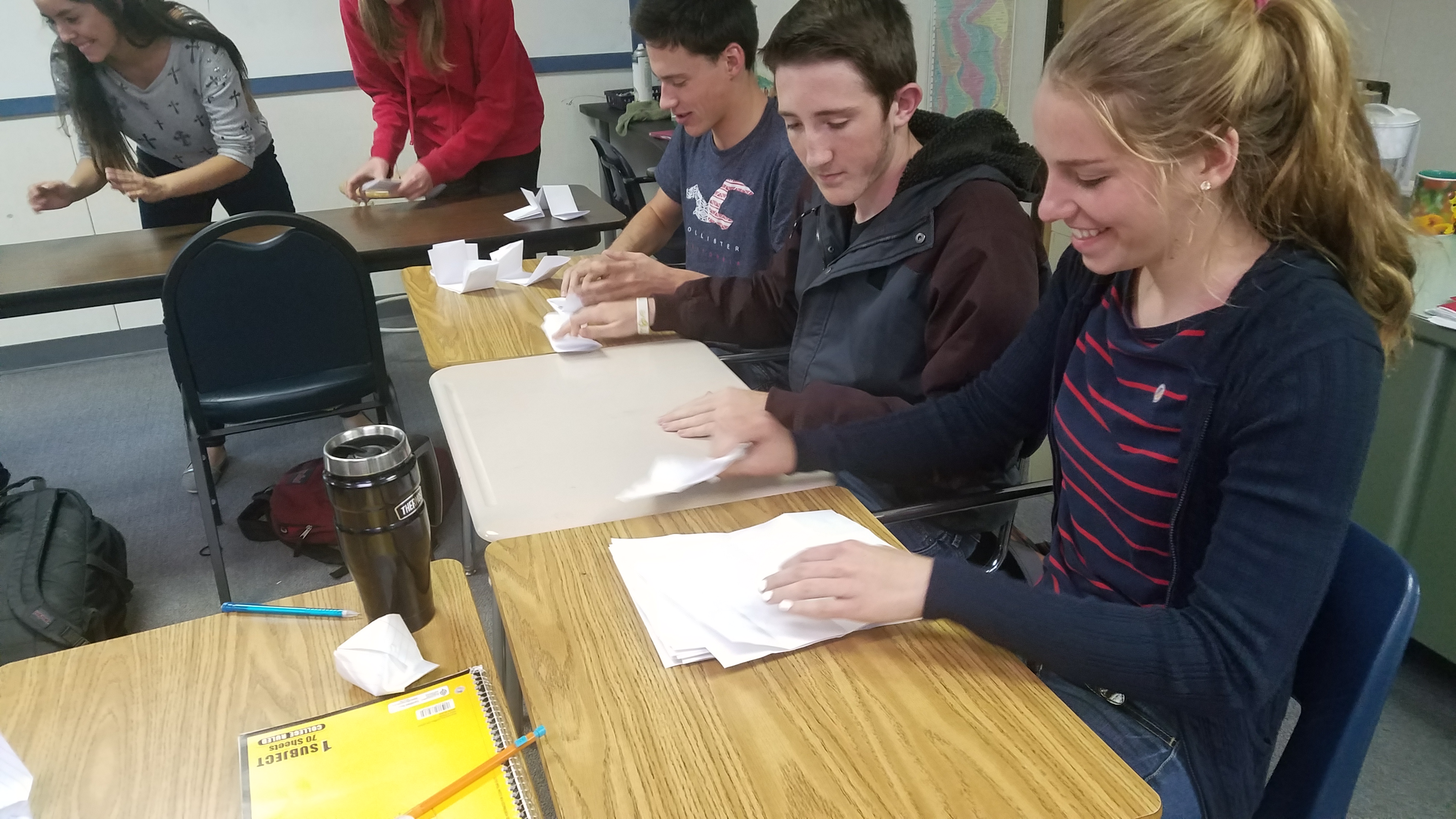
Assembly Line!

20170120_111034This week students have been learning about how Henry Ford put together his Model-T via mass production and the assembly line. To help them relate, students were first asked to fold as many sheets of paper as possible in one minute in an assembly line fashion, where each member of their team had one particular fold to make as the paper moved from the person before them. By the time the paper had passed through every team member, thereby reaching the end of the line, it had transformed into one, completed “widget.” Then, students were asked to fold as many sheets of paper within the same time frame and in the same folding pattern, with the only difference being that they would work individually, rather than as a team.

To about half of the classes’ surprise, the team folding (assembly line) production method produced more completed widgets faster than the individual production method. Now they understood one of the reasons why Henry Ford, as well as other major producers of the early 20th century, utilized assembly lines to increase production, lower costs, and raise revenue.

Taken from History.com, in 1913 Henry Ford installed the first moving assembly line for the mass production of an entire automobile. His innovation reduced the time it took to build a car from more than 12 hours to two hours and 30 minutes.

Ford’s Model T, introduced in 1908, was simple, sturdy and relatively inexpensive–but not inexpensive enough for Ford, who was determined to build “motor car[s] for the great multitude.” (“When I’m through,” he said, “about everybody will have one.”) In order to lower the price of his cars, Ford figured, he would just have to find a way to build them more efficiently.

The most significant piece of Ford’s efficiency crusade was the assembly line. Inspired by the continuous-flow production methods used by flour mills, breweries, canneries and industrial bakeries, along with the disassembly of animal carcasses in Chicago’s meat-packing plants, Ford installed moving lines for bits and pieces of the manufacturing process: For instance, workers built motors and transmissions on rope-and-pulley–powered conveyor belts. In December 1913, he unveiled the pièce de résistance: the moving-chassis assembly line.

In February 1914, he added a mechanized belt that chugged along at a speed of six feet per minute. As the pace accelerated, Ford produced more and more cars, and on June 4, 1924, the 10-millionth Model T rolled off the Highland Park assembly line. Though the Model T did not last much longer–by the middle of the 1920s, customers wanted a car that was inexpensive and had all the bells and whistles that the Model T scorned–it had ushered in the era of the automobile for everyone.

Uncle Tom’s Cabin

In 1851, after the enactment by the United States Congress of a Fugitive Slave Act (the effect of which was to return Africans and African-Americans who had escaped from slavery in the Southern states and were living in the North, back into captivity), the editor of an antislavery periodical asked Harriet Beecher Stowe if she could supply him with a timely story or article. Stowe agreed to write a fictional piece about the lives of several slaves on a Kentucky plantation.* This fictional piece, Uncle Tom’s Cabin, is written about actual people and their lives, although some characters were developed wholly by Stowe, all to illustrate the condition of slavery. The narrative wonderfully explains the 1850s from many different sides of the story. For well-rounded insight into this era, I highly recommend reading this book.

Students in our US History class have been reading Uncle Tom’s Cabin since the beginning of the school year. There intermittent tests on certain chapters ask critical thinking questions such as, “What does Eva’s death mean to you?” and “Why is this text worth reading?” also “There are many important ideas/themes in this book. Name three and explain why they are important.” and finally, “Rather than reading Uncle Tom’s Cabin for sheer pleasure, we are reading this book to understand and appreciate a worldview. According to you, what worldview might that be? Explain.” Below are some responses to these questions from students in our class. There is also a photo gallery below showing some of the writing of the students. So proud of them! Continue reading “Uncle Tom’s Cabin”

The Civil War Project

This month students in the US History class have been discussing the Civil War. This war is the central event in America’s historical consciousness. While the Revolution of 1776-1783 created the United States, the Civil War of 1861-1865 determined what kind of nation it would be. The war resolved two fundamental questions left unresolved by the revolution: whether the United States was to be a dissolvable confederation of sovereign states or an indivisible nation with a sovereign national government; and whether this nation, born of a declaration that all men were created with an equal right to liberty, would continue to exist as the largest slaveholding country in the world.

Northern victory in the war preserved the United States as one nation and ended the institution of slavery that had divided the country from its beginning. But these achievements came at the cost of 625,000 lives–nearly as many American soldiers as died in all the other wars in which this country has fought combined. The American Civil War was the largest and most destructive conflict in the Western world between the end of the Napoleonic Wars in 1815 and the onset of World War I in 1914.

As part of our education this month, students were asked to complete a project in teams which would illustrate their understanding of the Civil War.  One such team decided to create a song. Not only were the lyrics to the song were created by the student team, but they also sang it for our listening pleasure. I hope you enjoy!

Lyrics:

There’s a time, there’s a place

There’s a meaning for war

Are you sure, are you sure you know

What you’re fight—fighting for?


Sometimes it seems there’s no other way

But, why couldn’t both sides just free their slaves?


Now it brothers on brothers, a Civil War

Everybody’s always in need of more

Six hundred twenty thousand people dead

It can’t be counted how many tears were shed


The war began when the South bombed Fort Sumter

The North was unprepared and gave their surrender

Eighteen sixty-one to eighteen sixty-five

Four years passed and then there were few alive


Was it worth the blood, the people asked

The North was bigger stronger and were winning fast


Now it brothers on brothers, a Civil War

Everybody’s always in need of more

Six hundred twenty thousand people dead

It can’t be counted how many tears were shed


The North had won, the slaves were freed

The rising sun was what the people need

They put down their guns and reunited

A bloody war had just been fighted


Now it brothers on brothers, a Civil War

Everybody’s always in need of more

Six hundred twenty thousand people dead

It can’t be counted how many tears were shed


All information written above on the Civil War taken from: http://www.civilwar.org/education/history/civil-war-overview/overview.html#