America entered World War I 100 years ago — this art shows what it was like
Published yesterday from Business Insider!
Gus Lubin, Feb. 11, 2017, 11:00 AM – If you think the world is chaotic now, imagine living a century ago in the heights of World War I.
As we approach the 100-year anniversary of America joining the fray on April 6, 1917, the Pennsylvania Academy of the Fine Arts is holding the first major exhibition on American art and the war.
“The works in WWI and American Art help us see in fresh and unfamiliar ways where we were headed a century ago and, by extension, where we maybe headed today,” write curators Robert Cozzolino, Anne Knutson, and David Lubin (this reporter’s father).
American art was mostly pro-war, at least at first. None more so than Childe Hassam’s dreamy paintings of flags in New York City.

“Early Morning on the Avenue in May 1917” (1917) by Childe Hassam Addison Gallery of American Art, Phillips Academy, Andover/Art Resource, NY
For the continuation of this article and to see more art from the era, please follow this link: http://www.businessinsider.com/american-art-during-wwi-gallery-2017-2/#american-art-was-mostly-pro-war-at-least-at-first-none-more-so-than-childe-hassams-dreamy-paintings-of-flags-in-new-york-city-1
Share this:

Assembly Line!
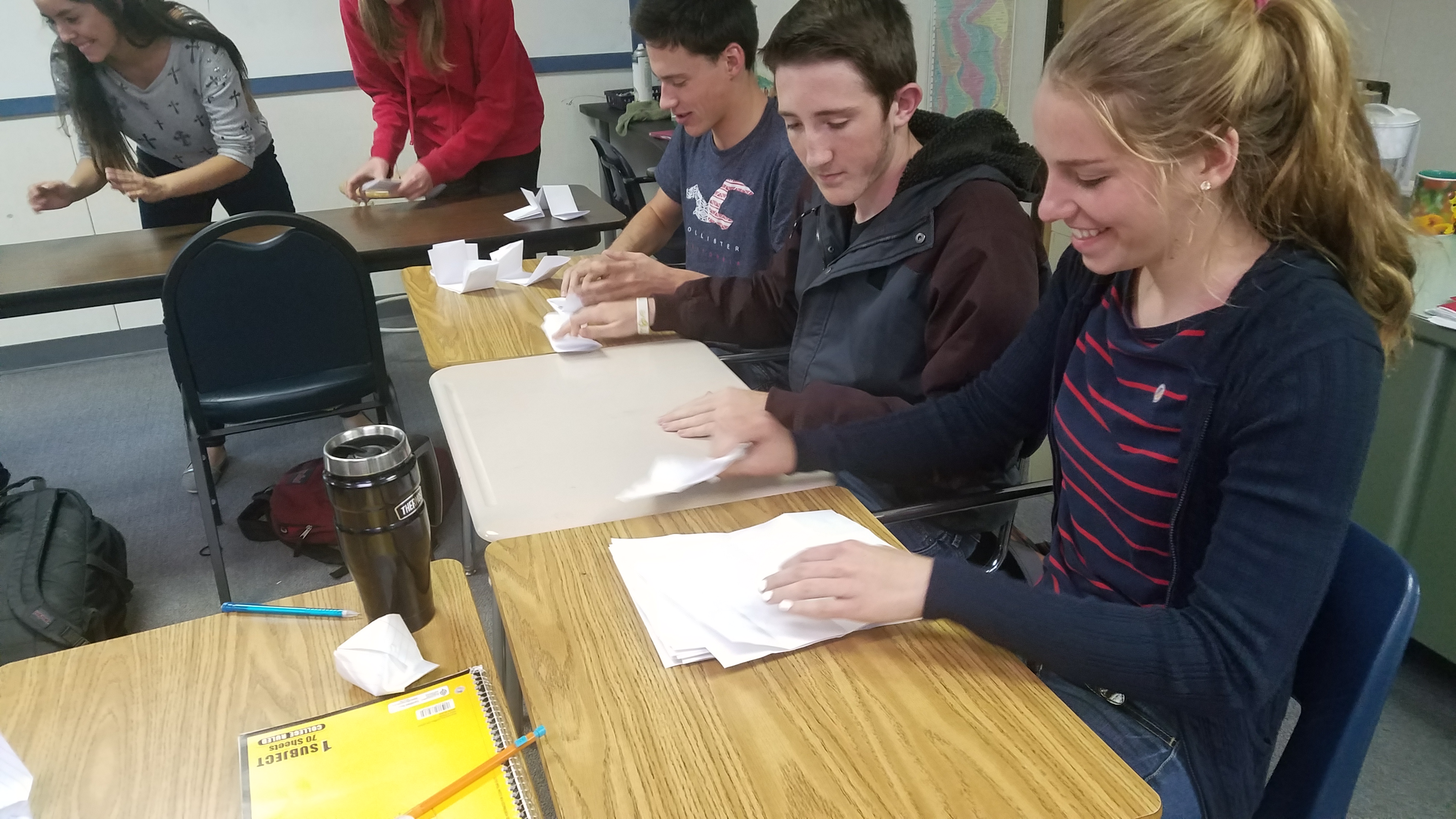 This week students have been learning about how Henry Ford put together his Model-T via mass production and the assembly line. To help them relate, students were first asked to fold as many sheets of paper as possible in one minute in an assembly line fashion, where each member of their team had one particular fold to make as the paper moved from the person before them. By the time the paper had passed through every team member, thereby reaching the end of the line, it had transformed into one, completed “widget.” Then, students were asked to fold as many sheets of paper within the same time frame and in the same folding pattern, with the only difference being that they would work individually, rather than as a team.
To about half of the classes’ surprise, the team folding (assembly line) production method produced more completed widgets faster than the individual production method. Now they understood one of the reasons why Henry Ford, as well as other major producers of the early 20th century, utilized assembly lines to increase production, lower costs, and raise revenue.
Taken from History.com, in 1913 Henry Ford installed the first moving assembly line for the mass production of an entire automobile. His innovation reduced the time it took to build a car from more than 12 hours to two hours and 30 minutes.
Ford’s Model T, introduced in 1908, was simple, sturdy and relatively inexpensive–but not inexpensive enough for Ford, who was determined to build “motor car[s] for the great multitude.” (“When I’m through,” he said, “about everybody will have one.”) In order to lower the price of his cars, Ford figured, he would just have to find a way to build them more efficiently.
The most significant piece of Ford’s efficiency crusade was the assembly line. Inspired by the continuous-flow production methods used by flour mills, breweries, canneries and industrial bakeries, along with the disassembly of animal carcasses in Chicago’s meat-packing plants, Ford installed moving lines for bits and pieces of the manufacturing process: For instance, workers built motors and transmissions on rope-and-pulley–powered conveyor belts. In December 1913, he unveiled the pièce de résistance: the moving-chassis assembly line.
In February 1914, he added a mechanized belt that chugged along at a speed of six feet per minute. As the pace accelerated, Ford produced more and more cars, and on June 4, 1924, the 10-millionth Model T rolled off the Highland Park assembly line. Though the Model T did not last much longer–by the middle of the 1920s, customers wanted a car that was inexpensive and had all the bells and whistles that the Model T scorned–it had ushered in the era of the automobile for everyone.

 The History of Humanity